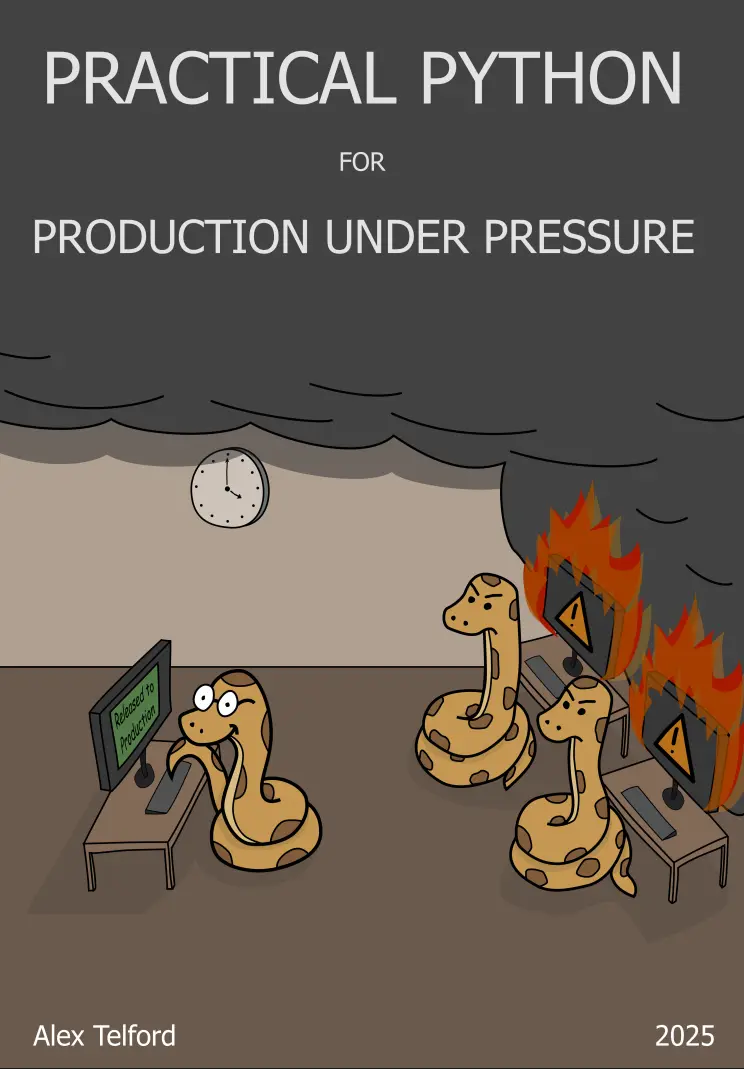
Practical Python for Production under Pressure: Managing the insanity that is developing pipelines alongside a production at full speed
Автор: Telford Alex
Дата выхода: 2025
Издательство: Lean Publishing
Количество страниц: 476
Размер файла: 3,6 МБ
Тип файла: PDF
Добавил: it-books
Table of Contents....4
Practical Python for Production under Pressure....7
Introduction....7
Frontline'' tools and Code Debt....9
Communication....13
Preparing for a task....13
Managing your workload....24
Getting Feedback....27
Tracking....28
Impostor Syndrome....31
Structure....33
Managing Environments with Rez....33
Structuring your project....49
Creating maintainable APIs....52
Schema....73
Designing with Diagrams....84
Creating maintainable Pipelines....89
Refactoring....94
Common Libraries....100
Testing....106
Automated tests....106
Production Data....113
Production Tracking....113
Wrapping APIs....145
Debugging....155
PDB....155
Exceptions....161
Inspecting....164
Crashes....171
Logging....174
Optimization....180
Profiling....180
Optimizing....185
Qt....208
Overview....208
Meta Data....210
Styles and Painting....216
State Machines....232
Responsive UI....246
Data Driven UI....267
Testing....281
QML in DCCs....298
User Experience....308
What is UX?....308
The 5 elements of UX....310
Research....316
Wireframing....318
Layouts....323
DataViews....337
Animations....346
Accessibility....347
Icons....351
Don't Make Them Think....357
Don't Make Them Wait....363
Adding Redundancy....370
Further Reading....373
AI....375
AI in Production Studios....375
AI Portals....376
Terminology....377
Data Security....381
Choosing an LLM....382
Prompt Engineering....385
Running Locally....393
AI Assisted Development....401
Developing AI Tools....446
Other Important Info....467
Legal Licenses....467
References....470
Afterword....476
Developing tools and pipelines for use in Film and Games is a unique challenge, where we must finely balance speed, stability, usability, and performance.
Everything is always urgent, everything is always broken, and we developers are left scrambling to hold the system together while begging production for time to "do things properly" and clean up accumulated code debt.
In a sense, it's like being in a pit crew; getting the driver back out there is your number one priority, sometimes with more duct tape than we care to admit.
That is what this book is about: how to deliver better tools while facing the uphill battle of a production in full swing and hopefully retaining some semblance of sanity at the end.
Prerequisites
This book is aimed at TDs and technical artists with an interest in production pipelines, but as it's mostly theory you should be able to get by with the basics.
Provided you have some experience with python and PySide you should get along fine.


