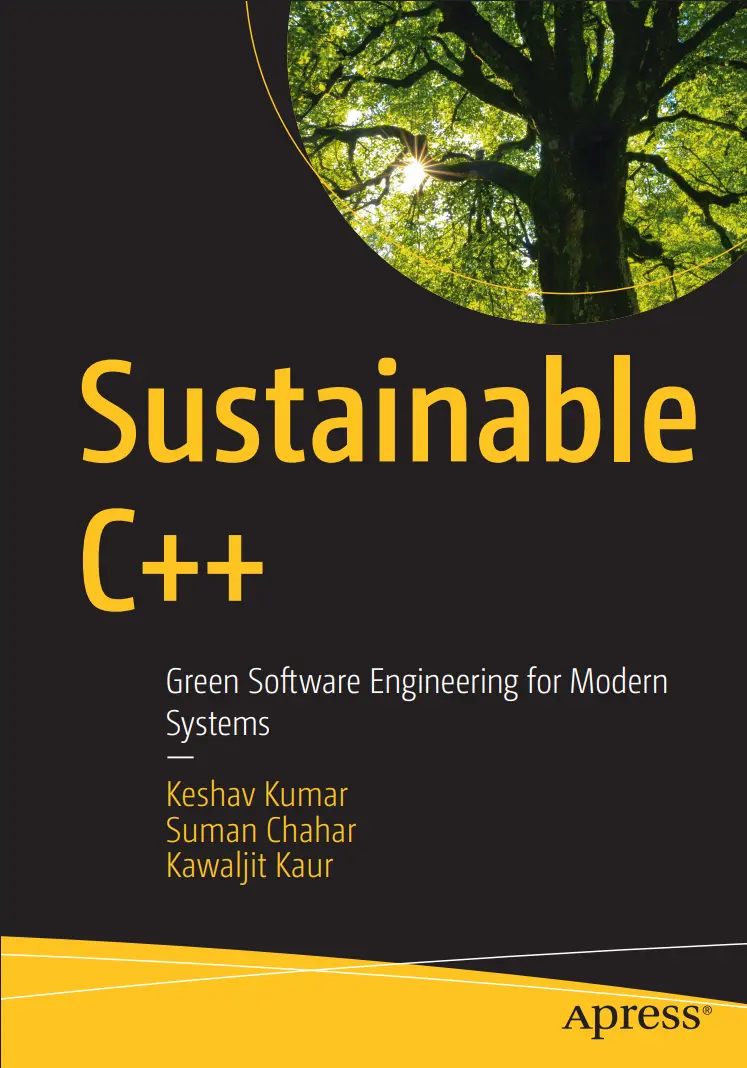
Sustainable C++: Green Software Engineering for Modern Systems
Автор: Chahar Suman, Kaur Kawaljit, Kumar Keshav
Дата выхода: 2026
Издательство: Apress Media, LLC.
Количество страниц: 515
Размер файла: 3,6 МБ
Тип файла: PDF
Добавил: it-books
Table of Contents....5
About the Authors....19
About the Technical Reviewer....21
Acknowledgments....22
Introduction....23
Chapter 1: Introduction to Modern C and Green Computing....25
Learning Objectives....25
Introduction....26
Modern C Evolution of Traditional C....28
Traditional C (C9803): Power with Complexity....29
The C11 Revolution: Foundation of Modern C....30
C14: Refinement and Performance Stability....31
Core Features of Modern C (C11–C23)....32
Move Semantics and R-value References (C11)....32
Smart Pointers and RAII (C11)....33
1. std::unique_ptr....34
2. std::shared_ptr....34
3. std::weak_ptr....35
Cyclic Problem Example....36
Memory Management and Energy Efficiency....37
Stack vs. Heap Energy Implications....38
Memory Fragmentation and Energy Waste....39
Deterministic Destruction and Energy Savings....40
Smart Pointers and Resource Optimization....40
Move Semantics and Performance Sustainability....41
Concurrency and Energy-Aware Multithreading....41
Cache-Efficient Programming....42
Measuring Energy Consumption in C Applications....42
Green C Profiling Open-Source Tools....42
Green Software Engineering Principles....43
Conclusion....43
Exercise for Readers....45
Section A: Multiple-Choice Questions (MCQs)....45
Section B: Frequently Asked Questions (FAQs)....49
Section C: Industry Interview Questions....49
Key Terms....50
References....50
Chapter 2: Efficiency in the C Language....53
Learning Objectives....53
Introduction....53
Dimensions of Efficiency in C....54
Core Language Refresher....56
Types of Values and References and RAII....57
Value Categories in C....57
References and Parameter Passing....59
RAII: Resource Acquisition Is Initialization....59
Compile-Time Programming....60
Mechanisms of Compile-Time Programming....61
1. constexpr: Conditional Compile-Time Evaluation....61
2. consteval: Compile-Time Execution....61
3. if constexpr: Compile-Time Conditioning....62
4. Type Inspection and Type Traits and Compile Time....62
5. Static Data, Compile-Time Constants....62
Efficiency Trade-Offs....63
1. Runtime Performance: Compilation Time....64
2. Binary Size vs. Speed of Execution....64
3. Flexibility and Predictability....64
4. Complexity vs. Readability of Code....65
5. Tooling Limitations and Debug Ability....65
Move Semantics and Perfect Forwarding....66
Move Semantics....67
Perfect Forwarding....68
Forwarding References....68
Template Metaprogramming in C....69
Evolution of TMP....71
Sustainability Perspective....73
Efficiency and Sustainability....75
Summary....77
Exercise For Readers....78
Section A: Multiple-Choice Questions (MCQs)....78
Section B: Frequently Asked Questions (FAQs)....82
Section C: Industry Interview Questions....83
Advanced Conceptual Questions....83
Coding Design-Based Questions....83
Optimization and Debugging Questions....84
Key Terms....84
References....85
Chapter 3: Memory Models and Cache-Efficient Programming....87
Learning Objectives....87
Memory Layouts and Patterns of Access....88
Memory Layouts....88
Linear Memory Representation....89
Row-Major and Column-Major Memory Organization....90
Stack vs. Heap: Energy and Performance Implication....92
Stack Memory....93
Architectural Overview of Stack....94
Life Cycle of a Stack Frame....95
Function Execution: Active Frame Phase....97
Nested Calls: Stack Growth....98
Heap Memory....98
Heap Architecture....99
Data Locality, Data Cache Lines, and False Sharing....102
Data Locality....103
1. Spatial Locality....103
2. Temporal Locality....104
Data Cache Lines....106
Key Characteristics of Cache Lines....107
1. Block-Based Transfer....107
2. Alignment Importance....108
3. Cache Coherency Protocol....108
4. Cache Line Utilization....108
False Sharing....108
Practical Optimization Guidelines....111
Low-Power Systems Allocator for Custom Systems....112
Complex Allocation Algorithms....113
Metadata Overhead....113
Fragmentation and Memory Waste....114
Frequent OS Interaction....114
Cache Inefficiency....115
Synchronization Overhead in Multithreading....115
Nondeterministic Allocation Time....116
Excessive AllocationDeallocation Churn....116
Smart Pointers and Memory Lifetimes....118
Memory Lifetime in C....118
1. Automatic Storage Duration....118
Lifetime Characteristics....119
Construction and Destruction Order....120
RAII and Automatic Lifetime....120
Performance Characteristics....121
2. Dynamic Storage Duration....122
Working of Dynamic Storage Internally....122
Characteristics of Dynamic Storage....123
1. Lifetime Independent of Scope....123
2. Flexible Size Allocation....123
3. Supports Complex Data Structures....124
3. Static Storage Duration....124
Types of Static Storage Duration....125
1. Global Variables....125
2. Static Local Variables....126
3. Static Class Members....127
Initialization of Static Objects....127
Destruction of Static Objects....128
Performance Characteristics....128
4. Thread Storage Duration....129
Basic Concept of thread_local....129
Memory Profiling Tools and Techniques....130
Categories of Memory Profiling Techniques....131
Conclusion....132
Section A: Multiple-Choice Questions (MCQs)....132
Section B: Frequently Asked Questions (FAQs)....137
Section C: Industry Interview Questions....137
Coding and Optimization Questions....138
Multithreading and Systems Questions....138
Memory Management and C Specific....139
Key Terms....139
References....140
Chapter 4: Data Structures and Algorithms: Efficiently....143
Learning Objectives....143
Introduction....143
Fundamentals of Data Structures....144
Data Structure Classification....145
Primitive or Basic Data Structures....145
Non-primitiveness Data Structures....145
Linear Data Structures....146
Arrays....146
Linked Lists....147
Stacks....150
Queues....154
Nonlinear Data Structures....158
Trees....159
Graphs....161
Hash Tables....164
Heaps....165
Time and Space Complexity....166
1. Time Complexity....166
2. Space Complexity....167
Fundamental of Algorithms....168
Searching Algorithms....168
Sorting Algorithms....171
1. Bubble Sort....172
2. Selection Sort....173
3. Insertion Sort....174
4. Merge Sort....176
5. Quick Sort....178
6. Heap Sort....178
Algorithm Design Paradigms....179
Divide and Conquer....180
Greedy Algorithms....181
Dynamic Programming....183
Backtracking....185
Efficiency Optimization Techniques....186
Practical Considerations in Modern Systems....187
Conclusion....188
Section A: Multiple-Choice Questions (MCQs)....189
Section B: Case StudyApplication-Based Questions....193
Section C: Higher-Order Thinking Questions (HOTS)....193
Key Terms....194
References....194
Chapter 5: Concurrency, Parallelism, and Coroutines....197
Learning Objectives....197
Introduction....197
Concurrency....200
Running Code: Concurrency (Multithreading Example – C)....201
Parallelism....204
Data Parallelism....204
Task Parallelism....205
Parallelism at the Instruction Level....205
Bit-Level Parallelism....206
Pipeline Parallelism....206
Benefits and Dilemmas of Parallelism....206
Coroutines....208
Types of Coroutines....210
Stackless Coroutines....210
Stackful Coroutines....211
Applications of Coroutines....211
Asynchronous Programming....211
Network Applications and Web Servers....211
Game Development....212
Real-Time Data Processing....212
Event-Driven Systems....212
Cloud Applications and Microservices....212
Challenges in Using Coroutines....213
Debugging Complexity....213
Managing Execution Flow....213
Resource Management....213
Handling Shared Data....213
Managerial Accounting: Error Handling and Exception Management....214
Coordination with Existing Systems....214
Implementation Techniques....214
Multithreading....214
Asynchronous Programming....215
Programming with Coroutines....215
Message Passing....215
Parallel Libraries and Frameworks....216
Synchronization Mechanisms....216
Applications in Modern Systems....216
Web and Cloud Computing....217
Big Data and Data Analytics....217
Artificial Intelligence and Machine Learning....217
Embedded Systems and Real-Time Systems....218
Multimedia Applications and Gaming....218
Internet of Things (IoT)....218
Challenges in Concurrency and Parallelism....218
Race Conditions....219
Deadlocks....219
Synchronization Overhead....219
Load Balancing Issues....219
Data Dependency....220
Communication Overhead....220
Complexity of Debugging and Testing....220
Scalability Limitations....220
Future Trends....221
Multi-core and Many-Core Architecture Development....221
Artificial Intelligence and Machine Learning: Integration....221
Improvements in Asynchronous and Coroutine-Based Programming....221
Distributed and Cloud-Native Computing....222
Energy-Saving and Green Computing....222
Quantum and Heterogeneous Visual Processing....222
Better Programming Models and Tools....222
Conclusion....223
Section A....224
Section B: Analytical Questions....228
Section C....228
Key Terms....230
References....231
Chapter 6: Profiling, Benchmarking, and Power Measurement....234
Introduction....235
Why Performance Analysis Matters....237
The Connection Between Performance and Sustainability....238
Understanding the Performance Analysis Workflow....239
Key Resources Analyzed During Profiling....240
Profiling, Benchmarking, and Power Measurement Tools....241
Profiling CPU, Memory, and Cache Usage....241
Understanding Profiling....242
CPU Profiling....244
Key CPU Profiling Metrics....244
Memory Profiling....246
Cache Profiling....247
Improving Cache Locality....249
Profiling for Sustainable C Development....250
Google Benchmark Techniques....251
Why Benchmarking Matters....252
Introduction to Google Benchmark....253
Writing a Basic Benchmark....254
Comparing Alternative Implementations....255
Parameterized Benchmarks....256
Preventing Measurement Errors....257
Throughput-Oriented Benchmarking....259
Benchmarking Best Practices....259
Benchmarking and Sustainable C....260
Software Energy Consumption Measurement....261
Understanding Software Energy Consumption....262
Power vs. Energy....263
Why Measure Software Energy Consumption?....264
Methods for Measuring Energy Consumption....265
Measuring Energy with Intel RAPL....265
Estimating Energy Consumption in C Applications....266
Energy-Aware Optimization Techniques....267
Challenges in Energy Measurement....268
Energy Measurement and Sustainable C....269
Hotspots Analysis and Inefficiencies....270
Understanding Hotspots....270
Identifying Hotspots....271
Types of Performance Inefficiencies....272
Algorithmic Inefficiencies....273
Excessive Memory Allocations....274
Unnecessary Object Copying....275
Cache-Related Inefficiencies....276
Concurrency-Related Hotspots....277
Energy Inefficiencies....278
A Systematic Approach to Hotspot Optimization....279
Hotspot Analysis and Sustainable C....280
Performance Analysis Tools: perf, Valgrind, Intel VTune, and NVIDIA Nsight....280
Linux perf....281
Memory Analysis with Valgrind....283
Intel VTune Profiler....284
NVIDIA Nsight....286
Choosing the Right Tool....287
Integrating Tools into Sustainable Software Development....288
Automation of Performance Testing Pipelines....289
Need for Automated Performance Testing....289
Performance Testing Pipeline Architecture....290
Integrating Google Benchmark into CICD....291
Detecting Performance Regressions....291
Automating Profiling Activities....293
Automated Energy Monitoring....294
CICD Platforms for Performance Testing....294
Reporting and Visualization....295
Best Practices for Automated Performance Pipelines....296
Automation and Sustainable C....297
Summary....298
Key Terms....299
Multiple-Choice Questions....302
Answers....306
Short Questions....307
Higher-Order Thinking Questions....307
Chapter 7: Sustainable Software Design Patterns....309
Learning Objectives....309
Foundations and Prerequisite Concepts....309
Transition from Optimization to Design....310
What Makes a Design Sustainable?....311
Scope of This Chapter....311
Minimal API and Lightweight Abstractions....312
Minimal API: Concept and Sustainability Impact....312
Lightweight Abstractions: Concept....316
Comparative Analysis....318
Overhead Reduction by Design....320
Reducing Data Movement and Copying Overhead....321
Reducing Allocation and Execution Overhead....322
Comparative Analysis....325
Zero-Cost Abstractions in C....327
Understanding Zero-Cost Abstractions....327
Eliminating Runtime Cost Through Design....328
Standard Library As Zero-Cost Abstraction....330
Comparative Analysis....332
Immutable and Functional Design in C....333
Concept of Immutability in C....333
Functional Data Flow and System Efficiency....336
Comparative Analysis....338
Energy-Friendly Error Handling....339
Rethinking Error Handling for Sustainability....340
Control Flow Predictability and Optimization....342
Comparative Analysis....344
Longevity and Maintainability Design....345
Designing for Long-Term Sustainability....345
Stability vs. Frequent Change....349
Comparative Analysis....350
Software Quality Metrics for Maintainability....352
1. Cyclomatic Complexity (CC)....352
2. Coupling....352
3. Cohesion....353
Summary....353
Key Terms....354
Multiple-Choice Questions....355
Answers....360
Short Questions....360
Higher-Order Thinking Questions....361
Chapter 8: Embedded and IoT Systems Green Computing....362
Learning Objectives....362
Introduction: The Green Footprint of Constrained Systems....363
The Hidden Scale of IoT Sustainability....363
The Hardware-Software Power Equation....364
The Philosophy of Green C....365
Foundations of Energy-Aware Design....366
Power States and Sleep Modes: The Art of Hibernation....366
Interrupt-Driven Architecture: Banish the Polling Loop....368
The Impact of Dynamic vs. Deterministic Behavior....368
Writing Ultra-Low-Power C for Microcontrollers....369
Shifting Work to Compile Time with constexpr and consteval....370
The Inefficient Approach (Runtime Calculation)....370
The Green Approach (Compile-Time Generation)....371
Avoiding the Cost of Object-Oriented Overheads....372
Type Safety Without Bloat: Modern Bit Manipulation....373
Template Metaprogramming for Tailored Hardware....374
Green Memory Management Techniques....375
The Carbon Cost of the Heap....375
Fixed-Size and Static Allocations....375
The Inefficient Approach (Dynamic Heap)....376
The Green Approach (Fixed-SizeStatic Buffer)....376
Cache Locality and Data Structures (Data-Oriented Design)....377
Sustainable Sensor Data Processing Algorithms....378
Downsampling and Edge Filtering (Dead-Banding)....378
Fixed-Point vs. Floating-Point Math....379
Implementing Fixed-Point Logic in C....380
Batching and Compression on the Edge....381
Battery-Aware Software and Communication Strategies....382
Duty Cycling Optimization: Race-to-Sleep vs. Low-and-Slow....383
Green Communication: The Cost of Airtime....384
Brownout and Battery Health Awareness....385
Measurement-Based Thinking: Profiling Energy and Workloads....386
Setting Up an Energy Testbed....387
Software Power Instrumentation....387
Case Study: Optimizing an IoT Sensor Node....389
Summary and Best Practices Checklist....390
The Holistic Green Embedded Architecture....391
The Sustainable C Best Practices Checklist....391
Summary....393
Key Terms....394
Multiple-Choice Questions....395
Answers....403
Short Questions....405
Higher-Order Thinking Questions....406
Chapter 9: Sustainable Build Systems and Tools....408
Learning Objectives....408
The Economics of Build Systems in Professional Environments....409
Modern CMake: From Scripts to Engineering....410
Target-Centric Design....410
Structuring Large Projects....411
Generator Expressions and Conditional Configuration....412
Compiler Diagnostics As a Quality Gate....412
Warning Profiles for Enterprise Codebases....412
Sanitizers in the Development Loop....413
Static Analysis at Scale....414
clang-tidy Integration....414
Include-What-You-Use (IWYU)....415
Build Performance Engineering....415
Profiling and Diagnosing Build Bottlenecks....415
Incremental Build Strategies....416
Distributed Build Systems....416
Dependency Management in the Enterprise....417
vcpkg: Microsoft's Open Ecosystem....417
Conan: Professional Dependency Server Integration....418
FetchContent for Internal Dependencies....418
CICD Pipeline Design for C Projects....419
Pipeline Stages and Gates....419
Build Caching in CI....420
Reproducible and Hermetic Builds....420
Key Techniques for Reproducibility....421
Supply Chain Security for C Build Systems....421
Dependency Verification....422
Software Bill of Materials (SBOM)....422
Signed Build Artifacts....422
Packaging and Distribution....423
CPack Integration....423
CMake Package Config Files....424
Build System Documentation and Onboarding....424
Summary....425
Assessment: Multiple-Choice Questions (MCQ)....426
Frequently Asked Questions (FAQs)....430
Interview Questions....431
Chapter 10: Applications and Case Studies in the Real World....433
Learning Objectives....433
Legacy Modernization: Refactoring Older C Applications for Energy Efficiency....434
The Mechanics of Green Refactoring....434
Code Case Study: The Cost of Legacy Strings and Vectors....435
The Legacy Approach (C98)....436
The Modernized Approach (Modern C)....436
Profiling Legacy Code for Energy Hotspots....437
Architectural Transformation: From OOP to Data-Oriented Design....438
High-Performance, Low-Emission Financial Systems....439
The Symbiosis of Speed and Sustainability....439
Code Case Study: Designing an Energy-Aware Order Book....441
The Low-Emission Order Book Parser....441
Minimizing Network Stack Emissions....444
Green Gaming Engines and Real-Time Physics Simulations....444
The Architecture of a Green Game Loop....445
Code Case Study: Optimizing a Particle Physics Pipeline....447
The Energy-Aware Particle System....447
Mitigating GPU Submission Bottlenecks....449
Sustainable Blockchains: Building Energy-Efficient Consensus Nodes....450
The Anatomy of Node Resource Leakage....450
Code Case Study: Zero-Copy Transaction Ingestion....452
The Low-Emission Mempool Processor....452
Mitigating Storage Power in Distributed Ledgers....455
Autonomous Systems and Robotics: Power-Constrained Edge Computing....455
Balancing Real-Time Latency and Energy Constraints....456
Code Case Study: Zero-Allocation Sensor Fusion Cache....457
The Energy-Aware Telemetry Cache....457
Maximizing Hardware-Accelerator Offloading....460
Summary and Best Practices for Real-World Green C....460
The Unified Blueprint for Green Software Engineering....461
Code Case Study: Bringing It All Together....462
The Fully Optimized Ingestion Loop....463
Final Thoughts: The Responsibility of the C Systems Engineer....465
Key Terms....465
Multiple-Choice Questions....468
Answers....474
Short Questions....475
Higher-Order Thinking Questions....475
Chapter 11: Future Opportunities in Sustainable C Computing....478
Overview....478
The Evolving Hardware Landscape and Its Implications for C....479
Heterogeneous Computing: CPUs, GPUs, NPUs, and FPGAs....479
Near-Memory and Compute-in-Memory Architectures....480
RISC-V and Open-ISA Opportunities....480
Language Evolution: C26, C29, and Beyond....481
Executors and Asynchronous Pipelines (P2300)....481
Reflection and Code Generation....481
Pattern Matching and Contracts....482
The Carbon Interoperability Language....482
Green Software Engineering Frameworks and C....482
The Green Software Foundations SCI Metric....482
Demand Shaping and Carbon-Aware Scheduling....483
OpenTelemetry Energy Extensions....483
AI-Assisted Sustainable C Development....484
LLM-Powered Refactoring for Energy Efficiency....484
Auto-Tuning and ML-Guided Compilation....484
Sustainable Systems Design Patterns for C at Scale....485
The Data-Oriented Design Renaissance....485
Compile-Time Computation and constexpr Maximalism....485
Memory Ownership, Fragmentation, and Allocator Hygiene....486
Network-Efficient C Services....486
Sustainable C in Embedded, Edge, and IoT Contexts....486
Organizational and Cultural Dimensions....487
Building Green Engineering Culture in MNCs....487
Sustainable C in Procurement and Vendor Evaluation....487
Upskilling and the Sustainable C Curriculum....488
Measuring What Matters: Energy Observability for C Systems....488
Looking Ahead: A Roadmap for Sustainable C (2025–2035)....489
Summary....490
Multiple-Choice Questions....491
Frequently Asked Questions (FAQs)....497
Interview Questions....497
Index....499
Write faster, cleaner, and more sustainable software with modern C++. This book offers practical techniques that combine contemporary language features with real‑world strategies to improve both performance and energy use.
You’ll explore capabilities from C++17 through C++26 and learn how they can support substantial carbon reduction in systems ranging from IoT and cloud platforms to embedded devices and high‑performance computing. Along the way, you’ll examine compiler optimizations, data‑layout choices, and profiling workflows that expose where software wastes energy, and how to fix it.
This book approaches green computing as an environmental priority that begins with the everyday programming decisions shaping a system’s energy footprint. By the end, you’ll understand how to make design choices that reduce power consumption, improve memory behavior, and support environmentally responsible software across modern applications.
What You Will Learn:
- Integrate modern C++ features with green‑computing principles
- Apply the performance–energy–memory triad to guide design decisions
- Leverage modern C++ language standards to build sustainable software
- Use sustainability metrics and coding practices to reduce energy and resource consumption
Who This Book is for:
Intermediate C++ developers who are familiar with modern C++ fundamentals and wish to deepen their understanding of performance-, energy-, and sustainability‑oriented software design, as they progress toward advanced and research‑level practices.


