Building Distributed Systems in the Age of AI: Designing Intelligent, Resilient Architectures
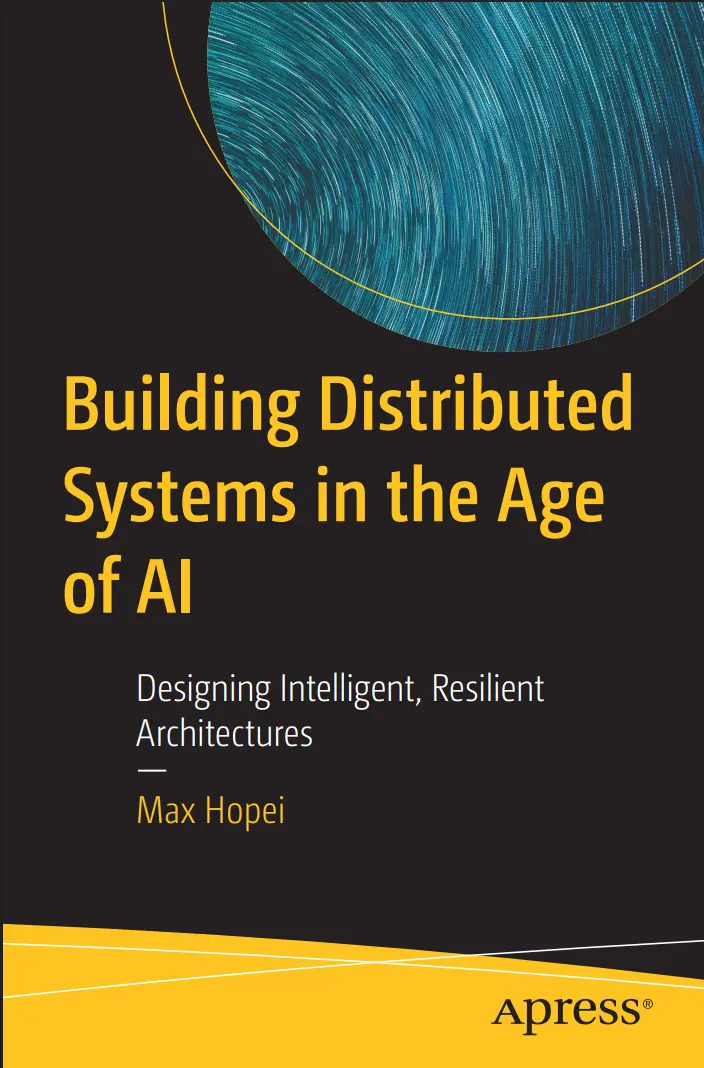
Автор: Hopei Max
Дата выхода: 2026
Издательство: Apress Media, LLC.
Количество страниц: 383
Размер файла: 2,7 МБ
Тип файла: PDF
Добавил: it-books
Table of Contents....5
About the Author....13
About the Technical Reviewer....14
Acknowledgments....15
Introduction....16
Part I: The Modern Technology....21
Chapter 1: Setting the Focus on the Right Things....22
Chapter 2: Revising Microservice Architecture....32
Three-Dimensional Service....37
Benefits of 3D Services....47
Challenges and Mitigations....49
When to Consider Alternatives....50
FirstWhat, ThenHow....50
The Most Trivial Thing....51
Layered Architecture....52
Domain-Centric Architecture....56
Use Cases....59
Invokers....63
Summary....67
Chapter 3: Message-Driven Architecture....69
Reactive Systems and Terminology....70
Message Types....72
Channel Types....74
Messages As Contract....80
Documenting....80
Format....83
Versioning....84
Messaging Across Systems....85
Foundational Patterns in Message Processing....86
Message Routing....86
Message Transformation....87
Integration Platform As a Service....89
The Bottom Line....92
Messages in Agentic Systems....92
Causality and Conversation Context....94
Reliability in the Face of Nondeterminism....96
Security and Trust Boundaries....96
The Bottom Line....97
Summary....97
Chapter 4: Streaming Architecture....99
Conceptual Shift from Service Applications....101
Semantics of Time....103
Building Blocks of a Streaming Platform....107
Data Plane....108
Ingestion Sources....108
Message Backbone....108
Compute....109
Storage....109
Serving Sinks....109
Control Plane....110
Orchestration and Deployment....110
Catalog and Schemas....110
Observability and Cost Control....111
Relevance for AIML Applications....111
On a Smaller Scale....113
Streaming Architecture for an Online Shop....113
Ingestion Sources....114
Message Backbone....114
Compute....114
Storage and Serving Sinks....115
The Bottom Line....116
Summary....116
Chapter 5: Agentic Architecture....118
Resemblance to Classical Services....120
Agent Loop....122
Tool Calling....124
Structured Output....126
Model Context Protocol....128
System Prompt and User Prompt....129
Memory....129
Retrieval-Augmented Generation (RAG)....133
Embedding....135
Vector Database....137
The Bottom Line....141
Security....142
Prompt Injection....143
Misusing and Abusing the Agent....147
Sensitive Information Disclosure....148
The Bottom Line....149
Agentic Platforms....150
Agents vs. Agents....151
Building Blocks....153
AI Workflow Automation Platforms....157
Frameworks and SDKs....158
Multi-agent Architecture....159
Orchestration....161
Choreography....162
Communication Between Agents....164
Agents As Microservices....164
Agents As Tools....165
Agent2Agent (A2A) Protocol....167
Observability and Explainability....169
Summary....170
Chapter 6: Real-World System Example....172
The Landscape....173
From Search to Ride....177
Finding a Vehicle....177
The Journey Begins....178
The Anomaly....181
The Proactive Response....183
The Complete Loop....186
The Integration Architecture....186
Chapter 7: Observability in Unpredictable Systems....188
The Implicit Contract....189
When Behavior Leaves the Code....191
Capturing the Reasoning....194
Structured Summary....194
Advanced Visualization....196
New Metrics and Feedback Loops....198
The Accountability Gap....200
The Diffusion of Observability and Explainability....202
The Economics of Observing Agents....203
The Evolving Tooling Landscape....205
Summary....207
Chapter 8: Systems Powered by AI....208
Level 1: AI Is a Tool....212
Level 2: AI Uses Tools....215
Level 3: AI Creates Tools....217
Summary....222
Part II: The New Engineer....224
Chapter 9: Using AI to Build Systems....225
It Is Still Fine to Write Code....227
When the Code Is Generated....230
Shaping, Not Writing....230
Learning to Delegate....231
The Fallacy of Intelligence....235
Methods for Working with Coding Agents....237
Vibe Coding....237
Scaffolding-First Development....238
Prompt Chaining....239
Spec-Driven Development....239
The Ralph Loop....240
Rules-First Development....242
Test-Driven Generation....242
Multi-agent Role Separation....243
The Bottom Line....244
The Impact Beyond Programming....245
Shifting Bottlenecks....245
The Shaking Ground of Education....248
Consequences for Hiring....250
Summary....252
Chapter 10: From Code for People to Code for AI....254
A Different Kind of Reader....257
What Still Holds and What Doesnt....261
Stable Anchors: Naming and Typing....264
Memory Files for Agents....266
Summary....267
Chapter 11: Programming Language for AI....269
Where the Languages Are Today....271
Market Pressure Without Spec Change....272
A Language Designed for LLMs....275
A Language Designed by LLMs....276
Special Purpose: Tool Orchestration....279
Natural Language As Source Code....283
Source Code As a Graph....285
The Bottom Line....288
Summary....290
Chapter 12: A Full-Stack Team for Distributed Systems....292
Are We All Full-Stack Now?....294
The Processes of the Team....297
Shifting Bottlenecks....298
Broken Estimations....300
Losing the Process....301
Losing the Ownership....303
The King Is Dead, Long Live the King!....305
Agents on the Team....307
The Octopus....307
Software ! Product....309
The Presence....309
What This Means....311
Part III: The New Audience....313
Chapter 13: Making Systems Approachable....314
Interfaces for Agents....316
Make Your APIs Agent-Friendly....316
Discovering Documentation....317
Semantic Responses....319
Next-Step Navigation....321
The Bottom Line....323
Provide an MCP Server....324
MCP vs. Traditional APIs....325
MCP vs. CLI....327
MCP Servers Discovery....329
The Bottom Line....330
Prepare Your UI for Agents....331
Add Shortcuts with WebMCP....332
Expose Your Agents via A2A....333
Interfaces for Non-Agent Systems....335
Events As a Public Contract....335
The Headless System....337
Summary....338
Chapter 14: Growing Privacy Pressure....341
It Was Already There....342
What AI Changes....343
Generous Us....343
Systems That Leak....345
AI on the Dark Side....347
Publicly Available....348
The Rules Are Catching Up....349
The Many Faces of Trust....350
What We Can Build....353
Summary....356
Chapter 15: Changing and Increasing Expectations....357
The Non-interface....358
Start from Where the User Is....360
The Generational Shift....361
What Replaces the Interface....362
What This Means for Engineers....363
Identity Without Interfaces....364
Agents in the Identity Model....365
Cross-Boundary Authorization....367
How They Interweave....367
The Architectural Answer....368
What Remains for Engineers....371
Summary....374
Index....375
This book provides a forward-looking guide to building distributed systems in the era of AI. It examines how foundational software architecture must collaborate and adapt to a world increasingly influenced by machine agents, real-time data streams, and autonomous behavior. As AI becomes a runtime component, rather than just a feature, traditional architectural patterns such as microservices, event-driven flows, and reactive design must be reinterpreted.
This book explores emerging strategies like agent-based architectures, streaming-first systems, and privacy-preserving AI infrastructure. It demonstrates how to create intelligent, resilient systems that remain observable and interoperable even as their behavior becomes more opaque and autonomous.
Beyond the technology, this book also addresses the evolving role of the software engineer. Code is no longer written solely for humans; it must now communicate clearly with large language models that read, generate, and reason about it.
Finally, the book assesses the machine-centric shift of the Internet. As AI agents increasingly consume content, activate APIs, and make decisions online, the design of interfaces, protocols, and privacy safeguards must evolve. Systems must now cater to two audiences: humans and machines with very different expectations. This book is aimed at software engineers, architects, and technical leaders navigating the next generation of distributed system design. It assists them in rethinking priorities, adapting skills, and designing systems that remain relevant, scalable, and safe in an AI-shaped world.
Today, a few years after large language models appeared on the tech radars, AI and agentic architecture are the central points of most tech gatherings, from small local meetups to large international conferences. However, when looking at any major programming language development roadmap, you’d have a hard time finding a proposal motivated by making a language friendlier to LLMs. The Python Steering Council, the TypeScript team, the Rust project, the Java, Go, C, and other teams—all of them publish their roadmaps and proposals openly, and those are remarkably free of AI-driven changes.
Python’s recent releases have focused on free-threading, a real JIT compiler, deferred evaluation of annotations, and template strings. TypeScript has been migrating its compiler architecture toward a faster, native implementation. Java focuses on pattern matching, structured concurrency, stable values, and some cleanup and hardening. Rust continues working through async closures, RTN, and the remaining gaps in async traits. Go ships small and predictable releases. Some of these changes can be beneficial for coding agents, but none were proposed in the words of “to make code easier for a model to generate.” They were items on the roadmap before the LLM inflection point, and they are being delivered on the cadence the roadmap allows.
You Will
- Learn how to serve modern complex use cases in the progressing environment by combining different architectures
- Discover how the responsibilities and skill sets of software engineers evolve in the context of AI-centric development
- Learn to shape systems for the new audience and demandss
This book is for
Software engineers, architects, and technical leaders.


