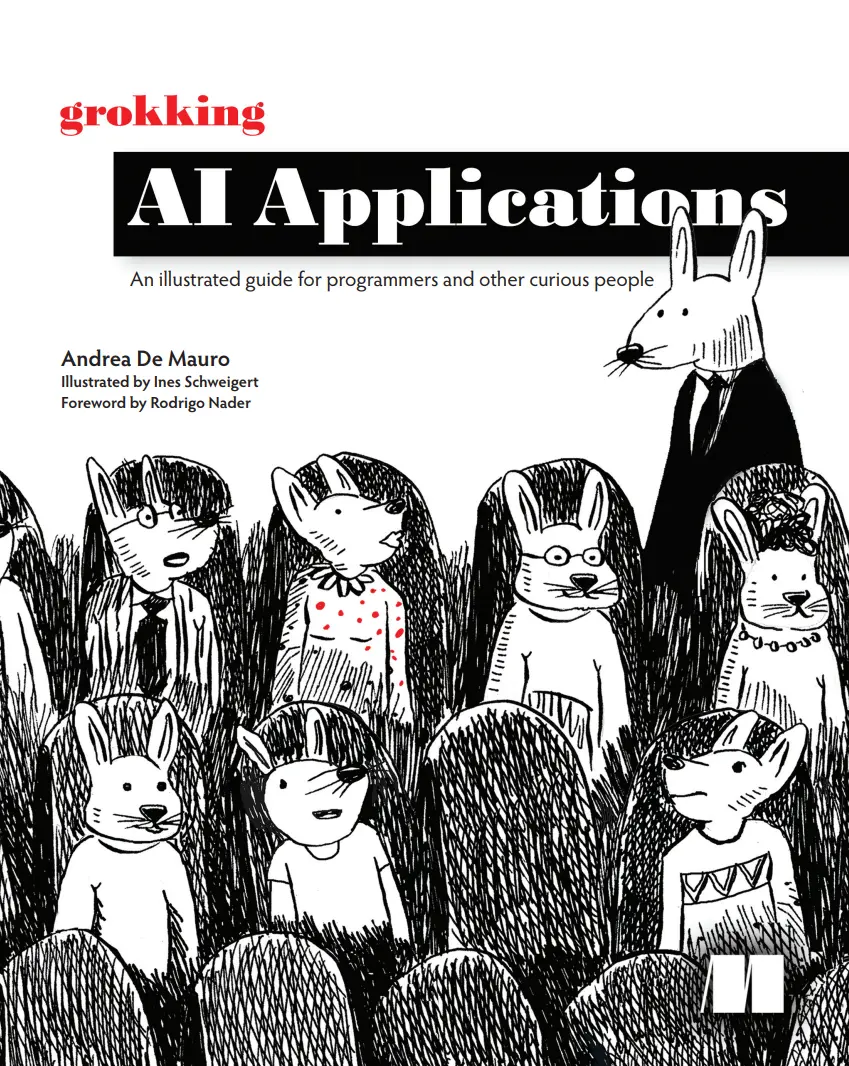
Grokking AI Applications: An illustrated guide for programmers and other curious people
Автор: Mauro Andrea De
Дата выхода: 2026
Издательство: Manning Publications Co.
Количество страниц: 272
Размер файла: 7,1 МБ
Тип файла: PDF
Добавил: it-books
Grokking AI Applications....1
brief contents....6
contents....8
foreword....12
preface....14
acknowledgments....16
about this book....18
about the author....22
about the illustrator....22
1 Peeking inside the black box....24
Our journey ahead....24
The uniqueness of GenAI programming....25
Dealing with LLMs....27
Building GenAI applications that extend LLMs....28
Inside the LLM....32
Understanding GPT: How a real LLM works....38
Summary....45
2 Building your first GenAI app....46
Wait a minute, low code?....46
Intro to Langflow....49
Hello, World! Our pirate chatbot....55
What if we coded it?....65
Summary....68
3 Writing the right prompt....70
What makes a good prompt?....71
Prompting enhancement techniques....76
Prompt templates in Langflow....80
What if we coded it?....91
Summary....95
4 Augmenting LLMs with your own documents....96
RAG in a nutshell....97
Building a RAG system in Langflow....106
Taking RAG to the next level....117
What if we coded it?....121
Summary....123
5 Expanding GenAI capabilities with tools and agents....124
Beyond words: When GenAI needs to act....125
Agents and tools....126
Building an agent in Langflow....131
Building a travel agent....137
Taking agents to the next level....145
What if we coded it?....148
Summary....150
6 Implementing agentic structures....152
From solo agents to agentic structures....153
Types of agentic structures....154
HealthyChef reimagined....156
Setting up an agentic copywriting team ....169
What if we coded it?....188
Summary....194
7 Integrating GenAI in your data ecosystem....196
Getting started with KNIME....199
Generating personalized emails at scale....204
What if we coded it?....230
Summary....233
8 Deploying and orchestrating GenAI apps....234
Deploying your GenAI app....235
Orchestrating GenAI apps....242
Setting up a culinary travel agent....246
What if we coded it?....260
Summary....263
Now what happens?....263
index....266
A....266
B....266
C....266
D....267
E....267
F....267
G....267
H....268
I....268
J....268
K....268
L....268
M....269
N....269
O....269
P....269
Q....269
R....269
S....270
T....270
U....270
V....270
W....270
Z....270
Grokking AI Applications: An illustrated guide for programmers and other curious people shows you how to create AI applications like chatbots, agents, and systems customized to use your own data—even if you’ve never built one before! Supporting his explanations with graphics and using concrete examples and hands-on implementations, author Andrea De Mauro gets you thinking about system design and mental models rather than boilerplate code and syntax debugging. You’ll quickly focus on the right level: how to manage prompts, data, and application components to get the results you want.
You’ll start with a bare-bones chatbot, as you learn how to create good prompts and improve accuracy using Retrieval Augmented Generation (RAG). To help your applications live in the real world, the book discusses how to connect them to document collections, structured databases, and CRM tools. You’ll build on this foundation, creating your own agents and equipping them with tools for data analysis and complex reasoning. Reviewer Julien Pohie of Thoughtworks commented, “The emphasis on multi-agent orchestration aligns perfectly with modern engineering best practices.”
Step-by-step guidance, rich diagrams, and workflow summaries help you stay oriented, even through advanced material. To emphasize conceptual and design thinking, you’ll start each project using the low-code development tool Langflow. For readers who want to go deeper, every example also includes fully-annotated Python implementations. You’ll see the code, libraries, APIs, and data behind each application, along with practical advice on how to deploy and monitor your applications.
Compact by design, this fast-paced book includes eight fully illustrated chapters that build intuition through engaging, memorable, and relatable real-world scenarios. As you read, you’ll experience a shift from AI as the familiar conversational chatbot to AI as an essential part of your application and, further, to the design of multi-agentic teams with specialized roles and supervised coordination.
And you’ll enjoy every page of the journey!
What's inside
- Low-code examples using Langflow and KNIME
- Core mechanics of RAG, agentic structures, and prompt engineering
- Practical AI projects including chatbots and reasoning agents
About the reader
For readers of all levels who want to create AI applications. The use of visual, low-code tools makes it accessible even to those unfamiliar with Python.


