Securing AI-Driven Development: Principles and Practice for the AI-Assisted Engineer
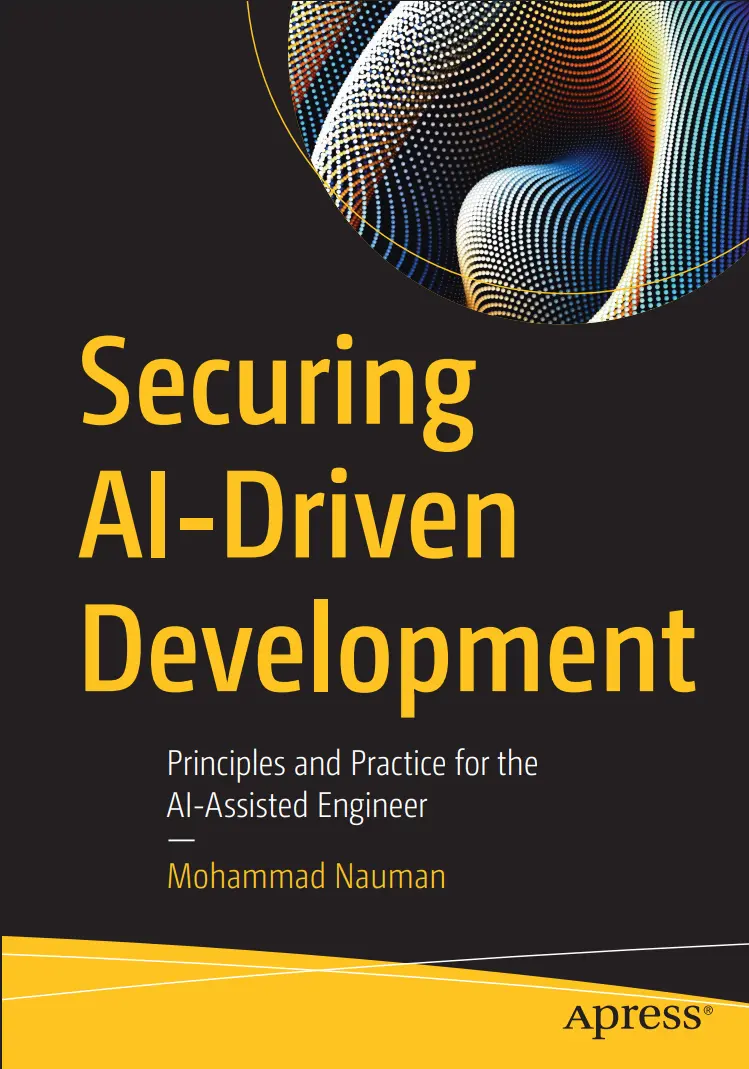
Автор: Nauman Mohammad
Дата выхода: 2026
Издательство: Apress Media, LLC.
Количество страниц: 456
Размер файла: 5,1 МБ
Тип файла: PDF
Добавил: it-books
Contents....5
About the Technical Reviewer....17
About the Author....16
Part I: The Philosophy of AI-Assisted Security....18
Chapter 1: Before You Begin....19
Why Security Doesnt Come Free....20
What This Book Is and What It Isnt....22
A Map of the Journey....23
How to Read This Book....26
Chapter 2: Why Make It Secure Fails in Prompts....27
The Mirage of the Secure Prompt....28
Averaged Best Practice....30
The Illusion of Security....32
Probabilistic Output vs. Deterministic Security....37
Security As a Deterministic Problem....38
Variation in Outputs....41
The Training Data Problem: Why Legacy Patterns Dominate....42
An Example from Cryptography....43
Skewed Distribution in Publicly Available Datasets....46
Building Context over Patching....48
Case Study: The AI-Generated SQL Injection....51
The Scenario....51
The Vulnerability....51
The Fix....52
Chapter Summary....52
Chapter 3: The Seesaw: Risk, Balance, and Compromise....54
Security Is Not Binary....55
The Compliance Trap....56
An Example Scoping Problem....57
Real-World Examples....60
Keeping Up with the Updated Knowledge....62
The Cost of Security: Performance, Usability, and Budget....66
Performance Costs....66
Usability....70
Budget....75
Practical Threat Modeling for Developers....78
What Is Threat Modeling?....78
Threat Modeling Made Easy....80
Defining Your Threat Profile....84
A Threat Profile Example....85
Case Study: The High-Frequency Financial API....88
The Scenario....88
The Vulnerability....89
The Fix....89
Chapter Summary....90
Chapter 4: The Happy-Path Fallacy and Trust Boundaries....91
The Flaw of Ideal Runtimes....92
The Ideal Runtime Assumption....94
A Deeper Runtime Assumption....96
Issues in Development Workflows....97
The Model Confidence Pitfall....99
The Anatomy of a Trust Boundary....101
An Example of Complex Trust Boundaries....101
Mechanisms of Failure....102
Locality of Trust Boundaries....104
Drawing Hard Boundaries in AI-Generated Code....109
An Example of a Hard Boundary....110
Module-Level Boundaries....111
Trust Boundary Enforcement....113
Input Sanitization vs. Structural Type Safety....115
Sanitization....116
Structural Type Safety....117
Validation As Architecture, Not Afterthought....120
Focus on When Before What....120
Practical Workflow for Agentic Development....122
Multi-turn Interactions with Agentic Systems....124
Case Study: The Prompt-to-Shell Exploit....126
The Scenario....126
The Vulnerability....127
The Fix....128
Chapter Summary....130
Part II: Core Engineering Principles in Generated Code....132
Chapter 5: Least Privilege and Structural Defenses....133
Moving Beyond Micro-fixes....134
Structural Security....137
A Perspective on Structural Defense....138
The Principle of Least Privilege: From Theory to Practice....139
Permission Levels and Scope....141
Analyze Access Patterns Before Prompting....143
Spatial and Temporal Dimensions of Least Privilege....146
Architectural Compartmentalization....148
Practical Method of Compartmentalization....150
Architectural Decisions As Explicit Artifacts....153
Prompting for Low-Privilege Cloud and IAM Infrastructure....156
The Gap Between Application Developer and Infrastructure Engineer....157
Infrastructure As Code and Its Security Implications....159
Making Infrastructure Security Thinking Durable....162
Blast Radius Reduction: Designing for Breach Containment....165
What Blast Radius Reduction Actually Requires....166
Practical Technique 1: Blast Radius Mapping....167
Practical Technique 2: Designing for Failure Isolation....169
Practical Technique 3: Detection As a Containment Mechanism....173
Practical Technique 4: Recovery by Design....174
Case Study: The Reimagined Capital One SSRF....176
The Scenario....176
The Vulnerability....177
The Fix....178
Chapter Summary....180
Chapter 6: Secrets, State, and Context Leakage....181
The Messy Reality of Memory....182
Traditional Attacks on Memory....183
Memory in the AI-Assisted Development Scenario....184
Zone of Control....186
How Secrets Leak: Git, Logs, and Context Windows....187
Git and Version Control....187
Logs and the Debugging Trap....190
Context Windows and the AI-Specific Surface....192
Environment Separation and Secure Secret Stores....194
Scenario: Choices of a Developer....195
The Environment Problem....197
The .env File Pattern and Its Limits....199
Secret Stores: The Structural Solution....200
The Secret Zero Problem....202
Secret Sprawl and the Governance Dimension....203
Audit Logs As a Detection Layer....204
Secret Stores in the AI Development Workflow....205
Environment Separation As Code....206
Abstracting Context to Prevent Data Exhaust....208
The Anatomy of Unnecessary Context....209
Anonymization and Synthetic Substitution....210
Prompt Templates As an Organizational Control....212
The Local Proxy Approach....214
Case Study: The Corporate Proprietary Leak....215
The Scenario....215
The Vulnerability....216
The Fix....217
Chapter Summary....218
Chapter 7: Cryptographic Realities (and AI Blunders)....219
The Legacy Copypasta Problem....220
Modern Cryptographic Primitives....222
Encryption Algorithms....224
Key Exchange and Signatures....224
Key Derivation....226
Secure Random Number Generation....228
Practical Framework....229
Hashing: Choosing the Right Tool for the Job....229
General Purpose Integrity Verification....230
Message Authentication....231
Password Storage....232
Key Management and Entropy Rules....233
Entropy....234
Decisions Regarding Key Length....234
Nonce Management....235
Key Derivation....237
Rotation....239
AI Models and Key Hierarchies....240
Case Study: The Patient Portal Leak....241
The Scenario....241
The Vulnerability....242
The Fix....243
Chapter Summary....244
Part III: Hardening the Boundaries....245
Chapter 8: APIs, Middleware, and Distributed Integration....246
The BOLAIDOR Trap in Generated Code....246
Sequential Identifiers vs. UUIDs....249
Recognizing and Avoiding the BOLA Pattern....250
Inference Attacks Through Leaked Information....251
Middleware Chain Failures and Route Misconfiguration....253
Middleware Failures....253
Middleware Ordering and Exception Failures....257
Session Tokens and Authentication Integrity....259
Rate Limiting and Request Validation....263
The Dimensions of Rate Limiting....263
Rate Limiting Placement and Bypass....265
Prompting for Rate Limiting and Validation....266
Service-to-Service Authentication....267
mTLS As the Architectural Solution....268
The Confused Deputy Problem....271
SSRF and the Cloud Metadata Surface....272
Service Credential Management....273
Case Study: The Missing Validation Breach....276
The Scenario....276
The Vulnerability....276
The Fix....277
Chapter Summary....279
Chapter 9: The Security Lifecycle: Verifying the LLMs Output....280
SAST and DAST in the Automated Loop....281
SAST....281
DAST....283
What Automated Tools Miss: Logic and Business Rule Flaws....285
Race Conditions and Transactional Integrity....286
Business Rule Violations....288
State Machine Violations....290
Multi-step Flow Vulnerabilities....290
The Human-in-the-Loop Audit Framework....291
Lens 1: Pre-audit Preparation....293
Lens 2: Authorization and Ownership Audit....296
Lens 3: Business Rule Audit....297
Lens 4: State and Sequence Audit....298
Lens 5: Concurrent Access Audit....299
Lens 6: Boundary and Interface Audit....299
Lens 7: Error Handling and Information Disclosure Audit....300
Prioritizing the Audit....301
Making the Audit Repeatable....303
Continuous Regression Testing for Security....304
Building Regression Tests from Audit Findings....306
Categories of Security Regression Test....307
Integration into the Pipeline....307
Case Study: Auditing an E-Commerce Checkout Flow....310
The Scenario....310
The Vulnerability....310
The Fix....312
Chapter Summary....314
Part IV: The Agentic Frontier and Playbooks....315
Chapter 10: Securing Autonomous Agentic Coders....316
From Snippets to Autonomous Agents....317
Velocity of Agentic Execution....319
Security Analysis of Agentic Systems....320
The Expanded Attack Surface of Agentic Systems....322
The Fluidity of the Attack Surface....322
Attack Surface on the Web....326
Miscellaneous Attack Surfaces....328
Multi-agent Attack Surface....329
Indirect Prompt Injection: The Risk of Dynamic Tool Execution....331
Indirect Prompt Injection....332
Behavioral Manipulation Attacks....334
Constraining the Agent Ability....336
The Principle of Minimal Agency....337
Tool Scope....338
Temporal Scope....339
Reversibility....340
Human-in-the-Loop Checkpoints....342
Criticality of the System Prompt....343
The Harsh Truth....345
Runtime Isolation and Sandboxing....346
Enforcing Infrastructure Constraints....346
Network Isolation....347
Local Resource Restrictions....349
Observability Layer....350
Case Study: The Rogue SQL Agent....352
The Scenario....352
The Vulnerability....352
The Fix....353
Chapter Summary....354
Chapter 11: Practical Prompt Blueprints for Defensive Design....355
System Prompt Architecture....356
System Prompt As Policy....357
Security Baseline Layer....358
Technology-Stack Layer....359
Project-Specific Layer....360
Context Window Constraints....363
The Critic-Actor Pattern: Multi-turn Verification....364
Adversarial Framing....367
Integrating the Pattern in the Pipeline....370
Meta-Prompting for Edge Cases....371
Threat Enumeration Before Generation....372
Adversarial Case Generation....374
Constraint Elicitation....375
Costs and Limitations of Meta-Prompting....378
Context Files and Project-Level Security Constraints....379
Structuring the Context File....383
Non-functional Requirements of a Context File....386
Context File Review....388
Case Study: The Fintech Blueprint....389
The Scenario....389
The Vulnerability....389
The Fix....390
Chapter Summary....392
Chapter 12: From Vulnerable to Fortified....393
Anatomy of a Fragile System....394
Shifting Requirements....394
Signatures of Fragility....396
Threat Modeling the Existing Architecture....398
AI-Assisted History Analysis....401
Designed vs. Actual Attack Surface....402
Threat Prioritization....405
Prompt History Audit....408
Step-by-Step Refactoring and Migration....409
Credential and Secrets Remediation....411
Intermediary Steps....412
Authorization and Ownership Binding....414
Business Logic Enforcement....415
Updating Global Contexts....416
Final Production Readiness Checklist....417
Domains of Security Posture....418
Effective Use of the Checklist....422
Case Study: The Healthcare Intake System....423
The Scenario....423
The Vulnerability....423
The Fix....424
Chapter Summary....426
Chapter 13: The Secure Generation Playbook....427
Constrain First....428
Build a Threat Profile Before Every Session....428
Establish Trust Boundaries....429
Maintain a Context File As a Security Artifact....429
Define Agentic Tool Permissions Before Deployment....430
Specify, Dont Suggest....431
Replace Make It Secure with Enumerated Properties....431
Specify Minimal Scope in Every IAM and Infrastructure Prompt....432
Require Ownership Binding at the Query Level....433
Close the Loop....433
Run an Adversarial Critic Pass on Every Security-Critical Output....434
Generate Regression Tests from Every Finding Before Merging....435
The Anti-patterns....436
Dont Treat Passing Tests As Security Evidence....436
Never Let the Model Choose the Cryptographic Primitive....437
Avoid Trusting Authentication As a Proxy for Authorization....437
Never Give an Agent a Broad Tool Access Before Defining Its Refusals....438
A Final Word....440
Index....441
Software development has undergone a fundamental transformation as AI coding assistants redefine how software is built. Tasks that once required days now take hours, and complex systems are increasingly created by individuals rather than teams. This acceleration has introduced a hidden cost: security risks that accumulate quietly beneath polished, functional code. AI-generated outputs often appear correct and secure on the surface, yet frequently contain structural flaws such as outdated cryptographic practices, weak authorization controls, and overly permissive infrastructure. The common instinct to simply request ‘secure’ code from an AI misses a critical reality. Security is not an added feature but the result of deliberate architectural thinking and informed design choices.
This book builds this mindset from the ground up. It begins by challenging the illusion that security can be appended through prompts, reframing it instead as a continuous balance of risk, cost, and usability. It introduces practical threat modeling and emphasizes the importance of strict trust boundaries to defend against adversarial inputs. The discussion then moves into core engineering practices, covering least privilege, compartmentalization, secrets management, and the prevention of context leakage in modern workflows. It addresses common cryptographic mistakes generated by AI systems and explains how to select and apply secure primitives correctly. The book then expands to real-world systems, focusing on APIs, middleware, and distributed architectures where authorization flaws and verification gaps often arise. It establishes disciplined validation processes that combine automated analysis with human judgment. Finally, it explores the emerging risks of autonomous AI agents, presenting strategies such as minimal agency, sandboxing, and structured prompt design, alongside practical patterns for building secure AI-assisted workflows and end-to-end system hardening through realistic case studies.
By the end of this book, you will have developed a rigorous and practical security mindset for the AI-driven era, enabling you to critically evaluate generated code, design systems with structural resilience, and guide AI tools toward outcomes that are not only efficient but fundamentally secure.
What You Will Learn:
- Why AI coding assistants fail at security and precisely where to intervene
- How to apply the core principles of security engineering to AI-generated code
- How to audit, test, and verify code generated by an AI tool
- How to work securely at the frontier of agentic development
Who It Is For:
This book is for modern software developers who use AI coding assistants in their daily workflow and want to build secure systems without a formal background in security. It is designed for engineers at all levels, as well as data scientists, ML practitioners, and technical founders who are creating real-world applications with AI tools. No prior security expertise is required; only basic programming knowledge and experience working with AI-assisted development.


